AI Sped Up Coding Faster Than It Sped Up Delivery
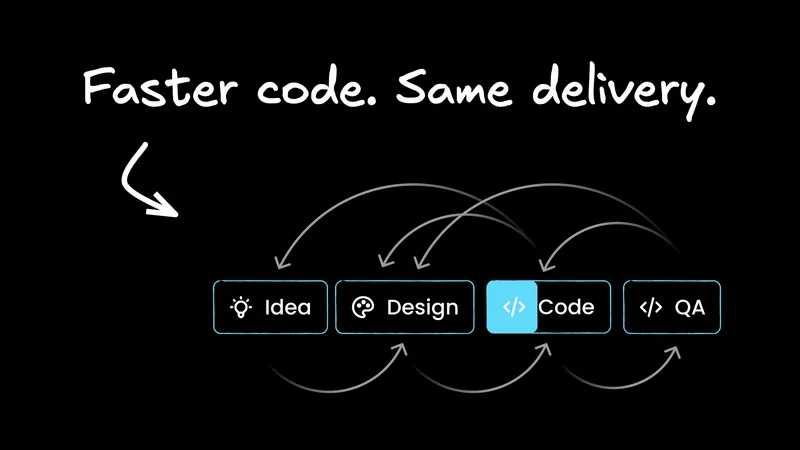
Faster coding has barely changed how fast teams ship, because the time that matters lives in the queues and handoffs between roles, not in writing the code.
Your developers are faster than they were a year ago. AI coding assistants write functions in seconds, clear boilerplate, and turn a rough idea into working code before lunch. Ask any engineer on your team, and you will hear the same thing. The work feels quicker, and they are right that it is.
Now look at your delivery metrics. Cycle time, deployment frequency, and the gap between a feature getting greenlit and a customer using it have remained mostly unchanged. The numbers describe a team that ships at roughly the same pace it did before anyone installed an AI assistant.
That gap between faster engineers and flat delivery has a straightforward explanation. The tools improved significantly in one specific part of the job, a small slice of the work between an idea and a shipped feature.
Coding was always a small part of the timeline
Think about where a feature actually spends its life. An engineer is only writing code for a slice of any given week, and the act of coding is only one stage in a longer chain that runs from idea to production. Most of the time between a feature getting greenlit and a customer using it is spent waiting in queues and moving between people, not writing code.
So AI speeds up a small fraction of a small fraction. The coding gets quicker, but the feature still takes about the same number of weeks to ship because most of those weeks were spent on tasks other than typing. Your engineer's afternoon got shorter, and the delivery date barely moved.
The time lives in the handoffs
A feature moves through a chain of people before it reaches a customer. Each link in that chain involves a person, a tool, and a wait for the next person to free up. The typical path looks like this:
- A product manager writes the spec and waits for design availability
- A designer mocks it up in Figma and waits for engineering capacity
- An engineer reads the mock, rebuilds it in code, and guesses at the interaction details the mock left ambiguous
- QA tests the build and files the issues it finds
- A reviewer reads the pull request, and either approves it or sends it back
Every transition between those steps is a translation between tools and between people, and every translation loses some of the original intent. The designer builds something the product manager did not quite picture. The engineer builds something the designer did not quite draw. The work then loops backward. Someone updates the spec, someone rebuilds the mock, someone reworks the code, and another sprint disappears into reconciling versions of the same feature.
A faster coding assistant leaves this entire structure untouched. It accelerates one link in a chain whose total length is determined by the waiting and handoffs between links. Speeding up typing while the queues and translations remain in place produces a feature that arrives almost exactly the same time.

Manual design-to-code translation eats a large share of sprint capacity on many teams, and the back-and-forth to clarify spacing, states, and interactions stretches that further. A senior engineer spends entire days rebuilding an approved Figma file pixel by pixel, decoding interaction details the file left implicit, then iterates two or three more times because something got lost between the design and the build. The feature logic that the engineer should be writing waits in the backlog the whole time. An AI assistant that speeds up the rebuild shaves time off the part of that story that was already the cheapest, while the clarification loops and the waiting remain exactly as long as before.
Why the speedup feels real, and the dashboard stays flat
The contradiction resolves once you separate the individual experience from the team experience. Each developer feels their work is getting quicker because the assistant operates within their personal task. The team continues to carry the same coordination overhead it always carried, because that overhead lives in the spaces between people.
You can give every engineer on the team the best AI assistant on the market and watch the team-level numbers hold steady. The delivery constraint has moved into handoffs, and a single-player coding tool has no reach into them. It works within a single person's editor, and the bottleneck lies in the gaps between editors.
The dynamic compounds, as teams add autonomous agents to the mix. A team running fleets of agents generates more changes, more pull requests, and more work that needs human review. Cheaper code production increases the volume of items awaiting coordination and sign-off. Pointing more agents at the existing workflow tightens the bottleneck, because the review and approval steps were already the slow part, and now they have more to process.
This is where most AI investments get measured at the wrong layer. Teams track how individual engineers feel and how much code an assistant can generate, and those metrics improve. The metric that matters to the business, how fast the whole team ships, barely moves.
What it takes to move the team metric
Improving team velocity requires working on the 99% of the timeline surrounding coding, which means collapsing the handoffs themselves. The goal is to remove the translations and the queues that sit between roles, so the team stops losing time reconciling versions of the same idea.
Picture the entire team working in one place, on the same real code, from the first moment a feature exists. The flow changes shape in a few specific ways:
- A product manager describes a feature to an agent, and the agent builds it against the actual codebase using the real components and design tokens.
- A designer opens the same branch and refines the UI directly on the live implementation, with the design system enforced so nothing drifts.
- An engineer reviews the diff and merges through the existing pipeline, keeping architectural ownership and merge authority.
- QA and other stakeholders review the running implementation, flag issues in context, and make changes themselves where possible.
No ticket sits in a queue waiting for a translation, because the whole team edits the same artifact. The product manager, the designer, and the engineer all touch the same branch, so the version that reaches the developer has already been checked against the real product by everyone who needed to weigh in.
The difference between the old chain and a collaborative one comes down to how many times work stops and changes hands. The table below lays it out.
| Stage | Handoff workflow | Collaborative workflow |
|---|---|---|
Idea to first build | PM writes a spec, then waits for design | PM prompts an agent that builds against real code |
Design refinement | Designer mocks in a separate tool, hands off to eng | Designer edits the live implementation directly |
Engineering | Engineer rebuilds the mock from scratch in code | Engineer reviews and refines an existing branch |
Review and QA | Sequentially, after the build is finished | In context, on the running implementation, alongside the build |
Net effect | Time set by queue depth and translation loss | Time is set by how fast the team can review and merge |
Where this leaves the tooling
A workflow like this needs a place where the whole team can work on the same production code. That is what Builder does. It connects to the real codebase, the design system, and the git workflow, so product, design, and engineering work on the same branches. Agents handle the frontend execution; humans handle judgment, architecture, and final approval; and changes ship through the existing CI/CD pipeline.
Because the platform reads the repository and indexes the components, tokens, and patterns, the code an agent generates uses the existing design system from the first draft, so there is no separate translation step from prototype to production. The generated UI already meets the standards, reducing the rebuild work that usually follows a handoff.

Developers keep the AI assistants they use inside their editors. The collaboration layer sits around that, letting the rest of the team work on the same real code, so the work moves from idea to shipped without stopping at every role boundary to translate and wait. Review stays the gate, approvals stay in the platform, and engineers keep merge authority, so the standards hold while the team moves faster.
Teams that run this way move more work, because the work doesn't sit in queues between hands.
The number that actually matters
An AI investment that shows up only in how individual engineers feel has improved the smallest part of the timeline. Coding speed has little effect on org-level delivery, because coding accounts for only a small fraction of the time between an idea and a customer using it.
The teams getting real gains have rebuilt the workflow so the whole team and its agents can build on real code together, and Builder is the platform that makes that possible. They measure the result in how fast the team ships.
Try Builder for free to see how the workflow runs on your own codebase, or schedule a demo to walk through it with the team.